4/20/17
Field Trip to Lake Crescent and Salt Creek
As an engineering student, it often feels like I'm encouraged to spend a majority of my time reclusively in quiet places where I can work out tons of abstract problems without getting a feel of the problems' manifestations in reality. Therefore, I'm ecstatic that not only can we have normal class periods for ENVIR 280 outdoors, but that I had the opportunity to explore and appreciate the beauty of our region on a weekend field trip to Lake Crescent and Salt Creek in the Olympic Penninsula. As I've been walking around campus since the trip, I realize both how much I learned during it and how my interest in plant and animal life has increased; I now give long looks at just about all of the trees, plants, and birds that I see and try to identify them. It may seem silly to some, but to me, knowing about the environment around me generally increases my interest in where I live and feels enlightening.
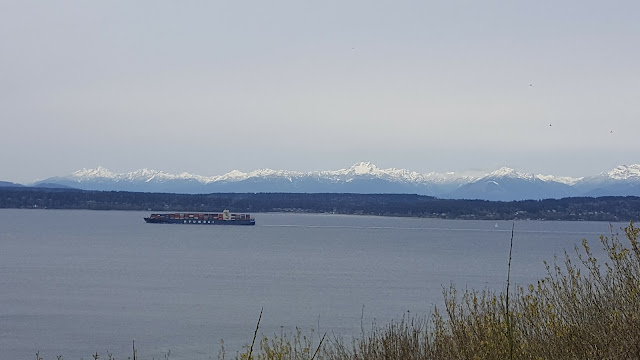
Once aboard the Edmonds ferry that crosses the Puget Sound, my immediate thought was how glad I was that I'd moved back to Seattle from the east coast. Looking over the azure water at snowtopped mountains and sprawling coniferous forests inspired a childlike desire to explore that is all to rare nowadays. Our first stop on our way to Lake Crescent was at a S'Klallam tribal site. What should've been a quick bathroom break became much more interesting as there was a bald eagle in a nearby tree that we got a very close look at with a telescope.
 |
| Bald Eagle (Haliaeetus leucocephalus) |
After a lunch break, I joined a group that was headed up Mount Stormking after taking a walk through the oldgrowth forest right beside Naturebridge. I probably would have called the forest oldgrowth due to the trees' enormity before I'd learned the true indicators of oldgrowth, however the characteristics outlined by B.U.N.S were clearly visible. The trees were huge, the canopy was uneven, and there were many giant nurse logs as well as snags.
 |
| Doug Fir (Joe for scale) |
 |
| A Madrone (Arbutus menziesii), possibly diseased, found higher up in the hike. Notice the soil and plants in the background- they differ greatly from the rich, wet, and dark soiled lowlands. |
 |
| The summit with the Strait of Juan de Fuca and Canada in the background. This channel was created by glaciers during the last ice age. |
On Saturday night, a group of us went out in search of owls. We were very quiet and used owl calls in an effort to illicit a response, but did so to no avail. The primary goal was to see a Spotted owl (Strix occidentalis), however their numbers have been diminishing in (relatively) recent years due to the expansion of the Barred owl (Strix varia) into the Olympics. Although the owl search was a bit of a let down, the stars over the lake were breathtaking. I spent an hour or two on the Naturebridge dock with a few other 'night owls' looking at constellations and planets that are essentially invisible from Seattle due to the glow of the city. Nothing, not even the enormity of a centuries-old Douglas Fir can astound me like the cosmos.
The next morning, I set out on my own (couldn't find a friend!) to see what birds I could find. I saw plenty of American Robins (Turdus migratorius), as well as a juvenile Pileated Woodpecker (Dryocopus pileatus). The only other bird I saw was difficult to identify, and I couldn't pinpoint a call to the specimen, however it was a small black bird with white spots and a black line across its back. Nevertheless, I saw a beautiful scene of the sun rising over the lake. I noticed that it was quite calm earlier on, but once you could see the sun on the land across the lake, the wind became ferociously cold. I'd hypothesize that phenomenon occurs due to a temperature imbalance of the air on either side of the lake, causing a current.
 |
| Looking west, down the path of the once oncoming glacier |
Later on, we set out for the tide pools of Salt Creek Recreation Area where we saw a plethora of new flora and fauna in a peculiar landscape. We arrived around low tide, which afforded us close looks at the aquatic and semiaquatic species that reside on rocks and bluffs where the land meets the sea.
 |
| An island (that is, during low tide) sculpted by oceanic erosion. The various hemlocks and doug firs atop it probably contribute to the cohesion of the landmass, however are somewhat stunted and visibly nutrient deficient. They stand among thick shrubs that appear to prefer and thrive in the hot, exposed platform |
Likely the most abundant species, covering a large percentage of the exposed and underwater rock, was the California mussel (Mytilus californianus), however the rock surfaces are far from homogeneous. Also common are Thatched (Semibalanus cariosus) and Goose barnacles (of the Pollicipedidae family) as well as many lichens and anemones. Below is an example of zonation on a rock face, although it is not immediately obvious what caused this difference. One possibility is that, because this is the apex of the surface, it is more often exposed to the air and is suceptible to predation and therefore not ideal for mussels and barnacles. Or, perhaps that brown lichen outperforms the mollusks and crustaceans for resources in this site. There are many possibilites, but due to its elevated position and specimen diversity, biotic and abiotic factors are certainly at play in the zonation.
 |
| Zonation, debatably caused by competition or varied exposure to sun and salt water, but likely both. |
 |
| Another example of zonation, with a clear boudary drawn between the rock with and without mussels. The elevation + diversity combonation is still at play, and I would hypothesize that some species such as mosses and lichens perform better than mussels at higher elevations. |
Below are two sketches of different species I saw in the tide flats, with accompanying photos:
 |
| A Mossy Chiton (Mopalia muscosa). Quite an odd creature, it feels ancient in a way with its simple, rocklike appearance and inanimacy. |

 |
| Giant Green Sea Anenome (Anthopleura xanthogrammica). All different shades of green, this spectacular creature has sticky tentacles that recede into the center of its body (towards its mouth) when they touch other objects: an effective way of retrieving food. |

After walking across much of the tideflats, I decided to work my way up to the 'island' to get a good view of the entire area. I found trail to the top, and after traversing it I met three paddle-boarders in wetsuits exclaiming about a whale. Sure enough, two to three whales were surfaceing every minute or so in the distance. I couldn't get a very good look at them, but the men were saying they were Gray Whales (Eschrichtius robustus), which is plausible as Grey whales migrate from Baja California in the winter to Alaska in the summer, indicating they were en route.
As the whales were surfacing, I witnessed something truly remarkable. An otter had taken hold of a Harlequin Duck 's (Histrionicus histrionicus) neck and was dragging underwater, to depths up to 4 feet. The bird flailed its wings splashing as it was dragged underwater where it released airbubbles and eventually drowned. I'm confident it drowned from the implications of releasing much air and an absence of blood. The otter, which is very likely a river otter (Lontra canadensis) as sea otters were hunted to extinction, then waited around for about 25 minutes, drying and scratiching itself ashore.
 |
| R.I.P. Harlequin duck. You sould have seen it coming--Darwinism at work. It is lying face up with its feet to the right. |
Then the otter retrieved the duck, brought it underneath a rock covered in crustaceans, and began tearing away at its victim. I caught a brief glimpse of a bloody duck neck through my binoculars when the otter neared the 'cave' entrance. Others said they even heard the chewing! This was certainly a morbid yet perplexing occurence, and I'm glad I got to see some candid natural interactions.
That was the final event of the weekend before we drove back to the ferry for Seattle. I am honestly amazed at how much I saw and learned in such a short period of time. This trip revived a sense of exploration that I'd lost for a long time, as I found myself wandering in nature guided by simple, raw intrigue. I'll finish off with one of my favorite sights of the weekend in sketch form:
 |
| A bleak white Mt.Baker towers over the region across the Strai of Juan de Fuca, with a couple hemlocks and tideflats in the foreground. Nothing like massive volcanoes to remind you of the grandeur of the universe, which is especially amazing while observing the endless intricacies of a tiny portion of it. |
 |
| Zoomed-in shot of Baker, taken where I drew my sketch. |


Comments
Post a Comment