Tuesday, 5/9/17
Sunny with some thin cloud coverage, 70 degrees, tide
partially out
 |
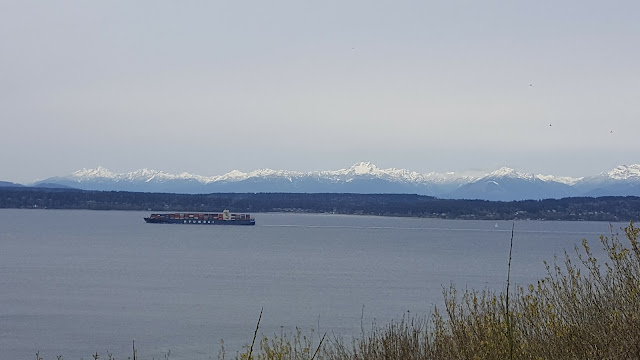
| My good camera broke, so this was taken with the lower quality front camera on my phone |
Another astounding day here out on the bluff. Mostly clear
skies reveal the Olympics across the Sound and even the upper half of that big
snowy cone to the south (Rainier). I love watching the massive ships make their
ways into and out of the sound simply because of their enormity, but I worry
for the habitats that their huge wakes are disturbing—not to mention the additional
damage caused by the mass expenditure of fossil fuels.
After arriving at my site, I walked around the perimeter
that I usually inspect and found just a few notable changes. Obviously, there
had been an increase in the height of the green shrubs that are lower to the
ground, particularly (and unfortunately) stinging nettle. I had to dodge many
nettles encroaching onto the trail. The plants on the ground reach up to about
2-3 feet at this point. Also new were the amount of plants that appear to be
just on the verge of budding their flowers. I don’t believe we studied the
plant that is doing so most prevelantly, but I will try to identify it with a
photograph.
I decided to walk a ways (100-120 meters) from my site parallel
to the bluff to get an idea of the diversity of the forest just outside of my loosely
defined site perimeter. After doing so, I realize how substantial the lack of diversity
of my site truly is; on my walk I saw a couple Western Redcedars (Thuja
plicata), many Red Alder (Alnus rubra), lots of Salal (Gautheria Shallon), Dull
and Tall Oregon Grape (Mahonia nervosa/aquifollum), and some Snowberry
(Symphoricarpos albus). I got lost on the trail and ended up bushwhacking for a
while. When I was back in the Panamanian mountains I was equipped with a machete
whenever I went off-trail, which made it much easier to navigate around unfriendly
plants which might’ve had unfriendly insects in them as well. This time, I was
not, so I had to be much more flexible and attentive. I’ve gained a new appreciation
for Indian-plum due to its ‘touchability’ and its tough branches that can push
away nettles.
So there was a general thickening of the forest and intensification
of its green, but no new/departed species as far as I’m aware, although I haven’t
been hearing bird calls as consistently as last week.
This week we've been tasked with finding and documenting invertebrates. Below are some sketches and observations of those that I was able to follow, although some were very difficult to stay close to. My handwriting is messy, so I'll rewrite the notes on the page.
 |
| Armadillidium vulgare--the common pill-bug (Order: Isopoda) -classic "roly-poly" bug because it curls up into a ball for defense -found in sandy soil -uniformly grey -wandering seemingly randomly |
 |
| Some kind of fly Order: Diptera -small, orangish, translucent - flying from leaf to leaf, slowly -6 legs-->insect-->hexapod -small, transparent wings (2, looked like possibly 4) -peachy color -probably half a centimeter long |
 |
| Some kind of spider. Order: Araneae -tiny white spider on the end of a blackberry bush stem -its back has a brown design that camouflages well with the end of the stem -light brown legs -mostly immoblie -not notably slow or fast -no nest/web nearby, just another black spider -keeps returning to the end of the stem |
A photo and video of the spider:

 |
| Difficult to determine the species, but it is an earwig. Order: Dermaptera -long insect (2cm) - like an ant with a "roly poly" attached to it, red -notched in the middle -found crawling in and out of the sandy bluff -drags its abdomen around like a snake drags its body -black pincers at its rear |
There were a few other invertebrates that I saw but didn't sketch and document as carefully. I saw a good deal of bumble bees (Genus: Bombus) as well as ants (Family: Formicidae), especially on the exposed, sandy areas around the bluffs and upended trees. I also saw a butterfly, the same kind that I was able to get a picture of for one of my earlier blog posts, but I was unable to identify it down to the species (Order: Lepidoptera). Other than that, I saw a few white larvae in the sand and many other tiny bugs/flies crawling and flying around, most of which were very difficult to observe for a long time. I was surprised at the difficulty of finding invertebrates when I set out to do it voluntarily, because I feel like when I'm not trying, a large variety of them are constantly making appearances.
The iuntricacies and diversity of invertebrate life truly boggles my mind. It makes me think about how often humans (rightfully) consider themselves such microscopic entities in this massive universe, but be that as it may, the scales of life get to be much smaller than our own.

Comments
Post a Comment