Walking from atop the bluff down to my site seemed oddly
different today than it was in days past. I think it must have rained this
morning because the sand was wet and the trees are damp and darker than normal.
The sandy pathway down from the bluff is drastically different from when I
first visited. It used to be relatively compact and trail-like, and now it’s a deep
trench filled with loose sand that acts more like a liquid than a solid,
causing me to slide a few inches with every step and send sand flowing down the
slope. The shrubs and small trees that line the path have clearly been tilting and
sliding (not to mention, growing), as many now block the path that was once clear.
I’d conjecture that the unusual amount of rain we’ve been having has played a significant
part in the erosion of the path, as well as increased foot traffic now that the
weather has been improving. Large chunks of soil are being carved out, and it’s
just a matter of time before there is a significant landslide that will likely
block the path and perhaps fell a larger tree. The path below the bluffs has
also changed significantly but in a different way: the vegetation now
encroaches significantly with tall shoots and leaves impeding the way. Most of
this overgrowth consists of Himalayan Blackberry and stinging nettle, but there’s
also a significant amount of Indian-Plum and grasses. The stream alongside my
site is loudly trickling—the sound of multiple days of rain from the past week making
its way to sealevel.
The Acers that make up the bulk of the canopy are now displaying
their macrophylla, the shadow of which on today’s cloudy day makes the forest
quite cool. Being from the northeast and the land of sugar maples, I’m truly
blown away by the size of these leaves. I can’t say I notice any new species,
but yet again the forest floor and canopy have thickened and intensified in
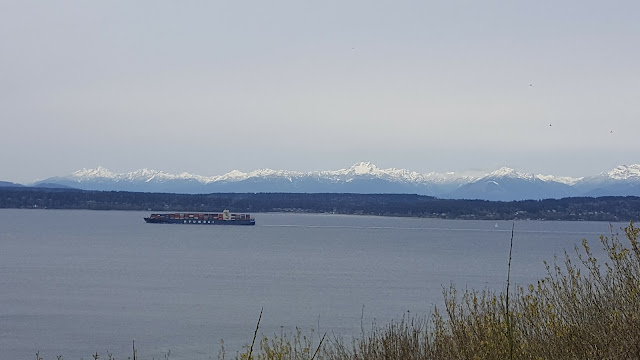
their green-ness, especially the mosses that cover the bases of the maple trunks. The Sound is almost completely hidden by the leaves.
Unfortunately, I forgot to bring my Sibley and Audubon guides, as well as
my binoculars, but regardless I tried to identify as many birds as I could. I
followed a couple to sketching and observe:
I saw a Red-Tailed Hawk (Buteo jamaicensis) perched on the highest branch of a maple tree. It was repeatedly it's voicing its shrill, piercing call. It was far in the distance and not really in a place to be observed carefully, however I watched it for a long time from the beach. It stayed perched for a long time, but flew once for a minute and got harassed by crows immediately.
Pitiful sketch, but some observations.
The first bird I followed was an American Crow(Corvus brachyrhynchos) that was on the tideflats. It was clearly feeding on various things underneath rocks, as it was constantly down pecking at them. It was part of a group of around 30 crows that were also feeding. Occasionally it would fly if itsaw others going somewhere that may have had food, but it stayed below ~10 feet above the beach. At first I thought it was feeding on crabs, but after closer obervation I think it was more likely feeding on clams, snails, and other small, chewy sea creatures. It was competing with some gulls nearby, both grey and white ones, for the food the tide had exposed. The gulls were picking up clams and dropping them, and the crow would try to swoop in and fly away before the gull got to its meal. However, it didn't seem to compete with other nearby crows, and they would all seperately look for food.
A couple sketches of the Crow
The second bird I followed was a Song Sparrow (Melospiza melodia). I found it hopping around the ground and flying to and from the lower branches of trees and shrubs like Indian-Plum. The sound of its wings as it flew was like a deep purr. It didn't seem to be feeding, as it was just going from branch to branch to the ground to branch, cocking its head at me when it was nearby. It wasn't right next to any other sparrows, however it was clearly exchanging calls with others in the vicinity as it would call and soon after there would be a response. Using the Audubon app, I played a number of calls that clearly confused and intrigued the sparrow. I played the alarm call which it repeated, and then many other nearby sparrows also repeated it, but they must have been confused how I, the danger, was the source of the call for danger. When I played more intricate songs, it would repeat them almost exactly.
I tried!
I also saw some other cool things nearby and on the tideflats:
Garter snake! (Genus: Thamnophis)
Crabs! Don't worry, I put the rock back into place.
I found the bases of these Barnacles interesting, they remind me of the rippled bases of volcanoes I saw in Guatemala.
I'm guessing these are eggs of some sort, they were underneath a rock with dozens of crabs underneath--crab eggs? Honestly I'm not sure if crabs even lay eggs and there were a bunch of other critters, so I still have some research to do.
Get link
Facebook
X
Pinterest
Email
Other Apps
Comments
Popular posts from this blog
April 11, 2017 1:20 pm About 50 degrees, bright, overcast The sky is white over the Puget Sound, although the clouds are high enough that I’m able to see a marvelous panoramic view of the entire snow-capped Olympic range. As I rode my bike over the summit of Discovery Park, I let out an audible “wow” in amazement at the spectacle. It’s a peaceful day here at my site. The sounds of birds chirping and a stream dwindling down the slope fill the air. In the distance I can hear the calm waves terminating at the shore and the wind rustling the trees. The most notable difference from last week is the increased amount of a vibrantly green moss that covers most of the lower areas of the forest’s tree trunks. After some close examination and comparisons with photos in Pojar, I’d conject that the moss is Ribbed Bog Moss (Aulacomnium palustre) or perhaps Long Hair Moss (Oligotrichum parallelum), however the mosses in the book look very similar. Another difference I see is the bu...
Tuesday, 5/9/17 Sunny with some thin cloud coverage, 70 degrees, tide partially out My good camera broke, so this was taken with the lower quality front camera on my phone Another astounding day here out on the bluff. Mostly clear skies reveal the Olympics across the Sound and even the upper half of that big snowy cone to the south (Rainier). I love watching the massive ships make their ways into and out of the sound simply because of their enormity, but I worry for the habitats that their huge wakes are disturbing—not to mention the additional damage caused by the mass expenditure of fossil fuels. After arriving at my site, I walked around the perimeter that I usually inspect and found just a few notable changes. Obviously, there had been an increase in the height of the green shrubs that are lower to the ground, particularly (and unfortunately) stinging nettle. I had to dodge many nettles encroaching onto the trail. The plants on the ground reach up to about 2-3 feet at...
This past Saturday, half of our class journeyed across the Cascades to visit and learn about the geological, biological, and climatic spectacles of the region. We would soon learn, that along with the change in culture, there is a drastic difference between the nature and its history of the west and east sides of the mountains. The day began with the drive through the Cascades headed to the Yakima Canyon. I volunteered to drive, and I’m glad I did, as it made me remain attentive throughout. The rolling hills appearance created by the drumlins of the Puget Sound region slowly turned into intense slopes with staggering peaks capped with snow. The alder lined highway gradually becomes more saturated with mountain conifers but the landscape remains incredibly lush. After a while, the mountainous landscape receded and became an arid shrub steppe filled with farms and agriculture. We took a brief break at a rest stop where I saw a sign on a booth that advertised free coffee. Intrigued ...




Comments
Post a Comment